


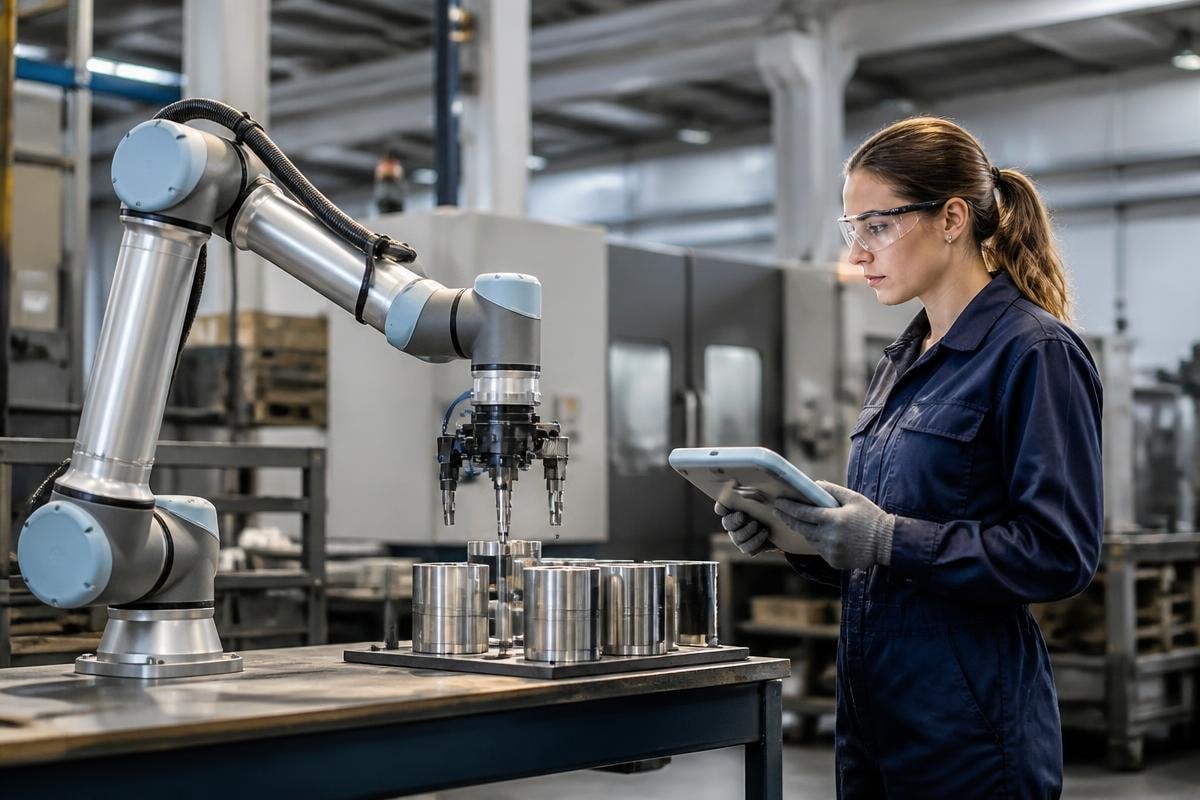
A robot won’t replace a missing electrician, welder, or maintenance technician. It can take over repeatable work, keep a trained worker on the tasks that need judgment, and make one person’s shift cover more ground.
Quick read
- Robots fit best where the task repeats and the work area stays predictable.
- Robots can assist with lifting, inspection, machine tending, or material movement.
- The hard part is usually setup, safety, and upkeep rather than the robot arm itself.
Start with the task, not the job title
A labor shortage often appears as an empty position, but that vacancy contains many separate tasks. A skilled worker may spend part of a shift loading a machine, moving parts, checking measurements, and fixing faults. Those jobs need different tools and different levels of judgment.
Robots can take over a task when its steps stay clear enough to program and check. A robotic arm can load parts into a machine, a mobile robot can carry bins across a work area, and a camera system can check a surface for visible defects. The worker still sets the process, handles unusual cases, and checks the result.
That split matters because training takes time. If a robot handles a repeatable movement, a new worker can spend more of their shift learning setup, diagnosis, and process control instead of repeating the same lift hundreds of times.
The fit depends on the work. Each setup needs a known pickup point, a defined drop-off point, and a safe way to stop when a person enters the area. A changing pile of parts or a task that depends on touch may need more sensors, a different gripper, or a person at the station.
Where automation can give workers more time
The strongest use cases have a clear handoff between the robot and the person. The robot performs the steady part of the job, then the worker deals with the part that needs inspection or judgment.
Machine tending is one example. The robot can move a part into a machine and remove it after the cycle ends. A technician can then spend more time checking tool wear, adjusting the process, or fixing a fault instead of waiting beside the machine.
Material movement works in a similar way. An autonomous mobile robot uses sensors and software to move through a mapped area, then stops at a set location for a person to load or unload it. That can reduce walking during a shift, though the site still needs clear routes, charging points, and a plan for blocked paths.
Inspection also benefits when the check has a visible rule. A camera can compare a part with a stored image or measurement range. A trained worker still needs to decide what to do with a borderline result, especially when a missed defect could affect safety or product quality.
A borderline inspection result still needs a trained worker to judge the part and choose the next step. Dated robotics reports from Robot24.com can show where a machine’s task ends and a worker takes over. That boundary leads to the work robots still leave behind.
The work robots still leave behind
Automation does not remove the need for skilled people. It changes where their time goes.
Someone must select the gripper, set the robot’s motion, connect it to nearby equipment, and test the safety controls.
After installation, the system needs checks, software updates, spare parts, and fault finding. Those jobs call for technicians who understand the robot and the process around it.
The system also needs a clear response when conditions change. A new part shape may require a new program. A sensor can become dirty. A damaged fixture can move the pickup point by a few millimeters and cause repeated failures. Good automation plans include these cases before the robot reaches production.
Cost matters too. The purchase price is only one part of the decision. You also need to count integration, guarding, training, maintenance, floor space, and time spent testing the work cell. A low-cost robot can still be a poor fit if the task changes every few minutes.
I’d start with one repeatable task that workers already understand well, then measure the handoff before expanding the system.
A practical check before buying
Use this list with the person who owns the process:
- Name the repeatable step: Write down the exact movement, inspection, or machine cycle you want to automate.
- Set the handoff: Mark where the robot stops and where a person checks, loads, repairs, or approves the work.
- Count the exceptions: Record the part changes, blocked routes, sensor failures, and unusual cases the system must handle.
- Plan the skills: Assign people to programming, safety checks, maintenance, and fault diagnosis before installation.
- Measure the result: Compare worker time on skilled tasks, cycle time, faults, and downtime against the current process.
This approach keeps the goal practical. The robot fills a gap in a process, while skilled workers keep control of decisions that the machine cannot make safely. The next useful step is a small trial with one task, one trained owner, and a measured result.
